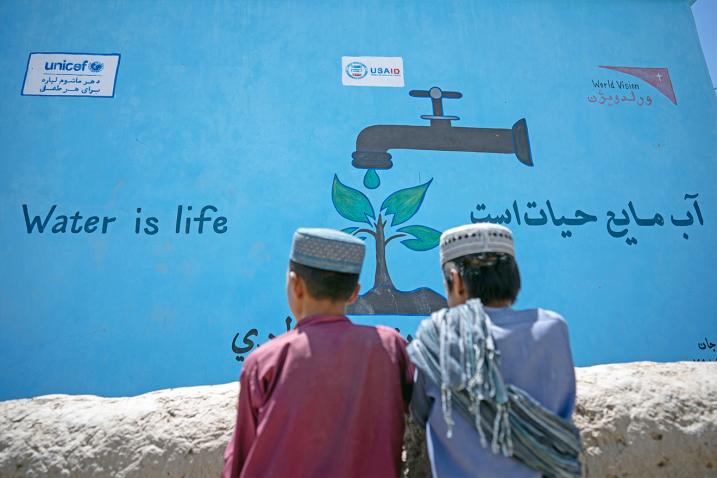
Water, Health and Human RightsSummary - Links - Introduction - Legal Recognition - Content of the Human Right to Water - State Obligations - Rights-based Approaches - Conclusions SummaryAround one sixth of the 6.1 billion people in the world lack access to improved sources of water, while 40% are without access to improved sanitation services (WHO 2000). This theme article explores the human right to water:
An annex to this article covers the instruments relevant to human rights to water across the world. LinksOther articles to this topic:
Disease fact files:
IntroductionThe Universal Declaration of Human Rights recognises the inherent dignity and the equal and inalienable rights of all human beings. Human rights standards and international humanitarian law are essentially an elaboration of this statement. There are certain basic needs that are essential for a dignified life, indeed for life itself. Water is one of these essential human needs and a clean environment is also increasingly recognised as a fundamental human right. Water scarcity, water and ground contamination and lack of access to water by the poor are among the main obstacles to full enjoyment of the right to water.1 The Special Rapporteur for the Sub-Commission on Prevention of Discrimination and Protection of Minorities.2 identified obstacles to the realisation of the right of access to drinking water supply and sanitation services. The obstacles include:
Legal Recognition of the Right to WaterUnder international human rights law, water is implicitly and explicitly protected as a human right. In the 1948 Universal Declaration of Human Rights and the two 1966 International Covenants on, respectively, Economic, Social and Cultural Rights (ICESCR), and Civil and Political Rights (ICCPR), water is not mentioned explicitly, but it is regarded as an integral component of other recognised rights, such as the rights to life, to adequate standard of living, to health, to housing and to food (Box 1). Access to water enjoys explicit protection under the 1979 Convention on the Elimination of all Forms of Discrimination against Women and the 1989 Convention on the Rights of the Child (see Annex). Under international humanitarian law applicable in armed conflicts, in particular the 1977 Protocols to the Geneva Conventions, starvation of civilians as a method of war is prohibited, and drinking water installations and supplies as well as irrigation works benefit from explicit protection (see Annex). Under international environmental law instruments, the right to a healthy environment has received increased recognition. Such right includes various substantive elements, such as the right to food and water, and the right to preservation of soil and water. Similar developments occurred in the area of freshwater management. The 1992 International Conference on Water and the Environment adopted a Statement acknowledging the basic right of all human beings to have access to clean water and sanitation at an affordable price (see Annex). Human rights and environmental provisions relevant to the right to water can also be found in the national constitutions of several countries (see Annex).
Content of the Human Right to WaterThe content of the right to water may be generally defined as a right to access to water of sufficient cleanliness and in sufficient quantities to meet individual needs. As a minimum, the quantity must suffice to meet basic human needs in terms of drinking, bathing, cleaning, cooking and sanitation. These needs correspond to those defined under a right to adequate housing.3 The minimum quality of household water is dependent on its specific use; drinking water must be safe for consumption, whereas lower standards may be set for water for sanitation.4 The right to water as part of the right to food is more complex. While drinking and cooking water would be protected, water for food production would probably not be covered under the minimum needs in arid areas, as agriculture production requires such high amounts of water that individual household needs must first be ensured. The same goes for water for industrial use: although industry and electricity are important for ensuring an adequate standard of living, these uses must not infringe on the right to household water. For both agriculture and industrial uses, contamination of drinking water must be prevented. Another aspect of water rights is affordability and accessibility. If a member of a household -most frequently women and girl-children- must walk for hours to fetch daily water, or if fees are so prohibitive that a poor household must sacrifice other essential rights, such as education, health services or food, or else use contaminated water, then individuals of that household are not enjoying their right to adequate water. State Obligations Regarding the Human Right to WaterIn considering state obligations, it is important to bear in mind that human beings are responsible for themselves and their own well-being. Human rights do not automatically involve heavy government intervention or imply that individuals can unreservedly demand goods and services from the state. However, current international human rights law is a system of state obligations: ultimately, each sovereign state is responsible towards the persons within its jurisdiction, and towards other states and international bodies, for the level of enjoyment of human rights in the country. It is a state's responsibility to regulate the behaviour of all actors within its jurisdiction, to ensure that these respect human rights, and to interfere in case of abuses. All human rights entail state obligations, which may be analysed at different levels.
The obligation to respect sets a limit to permissible actions by the state itself. A concrete example can be found in international humanitarian law, which forbids attacks on things essential for the survival of the population, including drinking water installations and supplies and irrigation works. While such provisions apply directly only in situations of armed conflict, it seems obvious that action forbidden by the Enemy State in war time is also forbidden by the state towards its own citizens in conflict and peace, by reference to human rights law, rather than humanitarian law. Development projects provide another example where states may fail to respect the right to water, if such projects may deprive the population of its water resources or render water undrinkable through pollution. It would thus normally not be consistent with human rights law to deprive people of access to water that they have enjoyed, without compensation or finding alternatives instead. The obligation to protect relates to the duty of the state to regulate the behaviour of non-state actors, individuals, groups and enterprises. Such obligation entails primarily the enactment of legislation and ensuring the effective functioning of the judicial system, for example in environmental legislation (Box 2). The protection of rights also implies, in the case of international water resources or transboundary basins, an obligation of equitable use by riparian countries through appropriate cooperation mechanisms.6
The obligation to fulfil is an obligation for a more positive action to facilitate and provide access to adequate water for those who do not have it. Examples of what this may involve include:
Such activities do not necessarily have to be undertaken by the state directly, but it should ensure that appropriate action is taken. User fees can be a practical way of regulating use and encouraging thriftiness. However, a water system that excludes certain groups who cannot afford to pay the user fees could be inconsistent with human rights. Therefore the user fees must be affordable for the poor, and even waived up to a certain limit, to ensure that minimum needs are met. Rights-based Approaches and the Human Right to WaterIn recent years there have been important developments regarding a general rights-based approach to human needs and to human development. This approach is based on the principles of participation, empowerment, non-discrimination, accountability, transparency and the rule of law as well as justiciability, meaning access to redress. It also entails that each individual is important, calling for aggregated data collection rather than just national averages.7 Viewing essential human needs as the right of every human individual is in itself of great importance, along with the recognition that all human rights are universal, interdependent and interrelated. This entails two key aspects:
Human rights are essentially about governance, what the state must and must not do, and which methods are acceptable or prescribed. For socio-economic rights, the rule of law is thus essential. A rights-based approach (rather than a charitable or developmental or an approach based on Gross National Product (GNP)) necessarily entails that the government must be transparent and accountable, that there is no discrimination on grounds of gender, race or social status, that the Government is taking steps towards achieving the full enjoyment of everyone in the country of their human rights, that there are legal remedies available and that people are allowed to organise to claim their rights. ConclusionsThis overview suggests the following conclusions:
1 The declining state of the world's freshwater resources may prove to be the dominant issue on the environment and development agenda of the coming century. Currently about 18% of the world's population lacks access to improved water services and about 40% lacks adequate sanitation (Global Water Supply and Sanitation Assessment 2000 Report). 2 The right of access of everyone to drinking water supply and sanitation services, Working Paper by El Hadji Guissé, Special Rapporteur, Sub-Commission on Prevention of Discrimination and Protection of Minorities, Fiftieth Session, Economic and Social Council, E/CN.4/Sub.2/1998/7, 10 June 1998., paragraph 29. 3 Committee on Economic, Social and Cultural Rights: General Comment 4, the Right to Adequate Housing, adopted 13 December 1991, UN doc. E/1992/23. 4 Peter Gleick: The Human Right to Water, 1(5) Water Policy, 487-503 (1999). 5 Committee on Economic, Social and Cultural Rights: General Comment 12, the Right to Adequate Food. UN document E/C.12/1999/5, 12 May 1999. 6 This concept of equitable use was codified in the 1997 UN Convention on the Law of Non-Navigational Uses of International Watercourses (Article 5 - Equitable and reasonable utilization and participation), and it was recalled by the International Court of Justice in the 1997 Gab?íkovo-Nagymaros judgement. 7 Julia Häusermann: A Human Rights Approach to Development, Rights and Humanity, London, 1998, ISBN 1 874680 02 7.
The World Health Organization is grateful for the co-operation of the Food and Agriculture Organization (FAO) and their contribution which is based upon their extensive experience in this subject area. Prepared for World Water Day. Written by Margret Vidar and Mohamed Ali Mekouar, Legal Office, Food and Agricultural Organization (FAO). Reviewed by the staff and experts from the Globalization, Cross-Sectoral Policies and Human Rights team (GCP), and the Water, Sanitation, and Health unit (WSH), World Health Organization (WHO).
| |||